









Latest Web3D News
Mar 11, 2010
Fraunhofer IGD, recently announced its X3DOM project. A test-environment to evaluate and evolve a DOM-based HTML/X3D integration model.
X3DOM is an experimental open source runtime, implemented in JavaScript and WebGL, which allows to inline X3D content in (X)HTML pages. It performs the current HTML5 specification for declarative 3D content and allows including X3D elements as part of any HTML5 DOM tree. An official release will be announced soon.
This model is based on ideas and code developed by Philip Taylor from University of Cambridge and provides a minimal X3D-runtime in JavaScript. The system uses the recently released WebGL for rendering and therefore renders hardware accelerated without any plug-in. However, WebGL is only available in alpha-builds from FireFox and WebKit at: http://www.x3dom.org/?page_id=9
The objective here is to include a live X3D scene in your HTML DOM, which allows you to manipulate the 3D content by only adding/ removing or changing DOM elements. No specific plug-in or plug-in interface like SAI is needed. It also supports some of the HTML events like “onclick” on 3D objects. 3dsmax exporter which can save to html/xhtml, a converter tutorial and now has BMW configuration showcase.
The Web3d Consortium’s X3D HTML5 Working Group presented a working demonstration with event passing to/from the HTML DOM using the X3DOM examples at the W3C TPAC meeting in Santa Clara, California in Nov 2009. At this meeting the Web3D HTML5 working group presented their thoughts and ideas on how to integrate X3D and HTML. In addition to the hour-long presentation, many other conversations and working demonstrations were given to W3C members during the course of the TPAC. The Web3D Consortium’s work was well received by W3C and the W3C HTML5 WG. The W3C HTML5 working group can be found at: http://www.w3.org/html/wg/.
This integration model is still evolving and open for discussions.There is more work to be done to further this effort. Anyone interested in getting involved please contact John Stewart. More information about the Working Group can be found at X3D-HTML5 .
Mar 10, 2010
Call for Participation in the IEEE Virtual Reality 2010 conference in Waltham, MA, USA on March 20 and 21, 2010.
Today, more than any time in the history of medicine, there is a need for faster, more efficient and cost effective training. Patient safety and evidenced based practice have been highlighted as key issues to be addressed by medical process and technology. There are many research problems to solve, including realistic modeling and simulation of physiological processes, human perception issues, time-efficient segmentation and effective use of haptics.
A half day workshop will be organized by the Web3D Consortium Medical Working Group to demonstrate the current state-of-the-art in medical virtual environments and identify future technology directions, and is requesting submission of technology related position papers (up to 3 pages) containing preliminary results of research or design work within the scope of medical virtual environments. Papers should address one or more of the following topics, although authors should not feel limited by them. Unlisted but related topics are also welcome.
* Novel applications/case studies of medical virtual environments, including training, rehabilitation, rehearsal, etc.
* Software algorithms and APIs
* Use of haptics for medical simulation
* Human perception and interaction with a virtual patient
* Physiology modeling techniques
* Standards for 3D medical imaging
* Inexpensive solutions
* Open Source Software and production pipelines
More information is available at: http://www.hpv.cs.bangor.ac.uk/vr10-med/
Dec 28, 2009
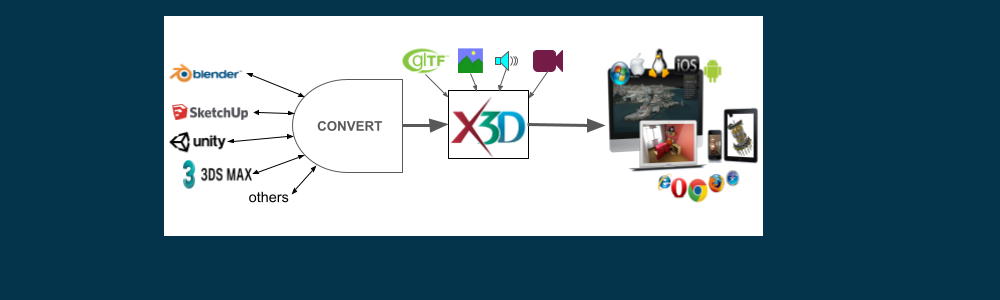
X3D a write once, render anywhere, anytime 3D graphics format for HTML 5.
As W3C is working on adding support for 3D in HTML 5, the Web3D Consortium’s X3D-HTML5 Working Group is working closely with W3C presenting their thoughts and ideas on how to integrate X3D and HTML. The goal here is to have a DOM-integrated cross-platform open-standards 3D graphics in every browser.
X3D is an abstracted graphics format; as long as the underlying OS and hardware supports some form of pixel display, X3D can be rendered on it. Whether your device uses one of the Direct-X graphical libraries, one of the continually evolving series of OpenGL versions, or some as-yet unwritten low-level graphics layer, X3D will be able to render on it, and if that device contains user i/o capabilities, X3D will be able to use that capability, too.
For more details on now X3D and HTML5 will fit with other 3D technologies please read the recent 3d-test interview with Web3D’s X3D-HTML5 Working Group chair John Stewart at: http://www.3d-test.com/interviews/x3d_2.htm.
Demonstration with event passing to/from the HTML DOM using the X3DOM are available at: http://www.x3dom.org/?page_id=9. X3DOM is an experimental open source runtime, implemented in JavaScript and WebGL, which allows to inline X3D content in (X)HTML pages. It performs the current HTML5 specification for declarative 3D content and allows including X3D elements as part of any HTML5 DOM tree.
This integration model is still evolving and open for discussions.There is more work to be done to further this effort. Anyone interested in getting involved please contact John Stewart. More information about the Working Group can be found at X3D-HTML5 .
Dec 03, 2009
“The first Augmented Reality Development Camp (AR DevCamp) will be held on Saturday December 5, 2009 at the Hacker Dojo in Mountain View CA and simultaneously in New York City and around the world!
After nearly 20 years in the research labs, Augmented Reality is taking shape as one of the next major waves of Internet innovation, overlaying and infusing the physical world with digital media, information and experiences. AR must be fundamentally open, interoperable, extensible, and accessible to all, so that it can create the kinds of opportunities for expressiveness, communication, business and social good on the web and Internet today. As one step towards this goal of an Open AR web, the AR DevCamp 1.0, will have a full day of technical sessions and hacking opportunities in an open format, BarCamp style. For more information about this camp please visit www.ardevcamp.org.
Web3D Consortium will be showcasing their open standards X3D implementations for Augmented Reality at this camp. Join us and see how you can use X3D today for your Augmentent Reality needs.

X3D WG to present X3D and HTML integration at W3C Technical Plenary and Advisory Committee Meeting
Nov 02, 2009
The X3D Working Group is participating in the HTML Working Group for the purpose of best integrating X3D with HTML.
This effort has strategic importance for Web3D and indeed for all 3D graphics, since X3D is an interchange format for a wide variety of models. We intend to establish a solid foundation for X3D to properly support 3D graphics in HTML5.
The X3D Working Group is considering three basic approaches to display an X3D scene inside an HTML page:
* External reference - HTML page includes an object element tag that refers to an .x3d scene, implemented via an X3D plugin. Data might be passed within the page using DOM events.
* X3D as XML in HTML - HTML page directly includes X3D source, likely with an XML namespace prefix, presumably implemented via an X3D plugin or the browser itself. Again data might be exchanged within the page using DOM events.
* API access - HTML page includes some form of canvas (or maybe Canvas3D) element that allows programmatic access to the page, so that X3D Scene Access Interface (SAI) might draw a bitmap
Variations on these approaches are considered as part of X3D and HTML5 examples and the X3DOM test site .
The X3D and HTML5 Summary will be presented at the HTML5 Working Group sessions Friday, November 6 2009 from 9:00 AM -10:00 AM in Mountain View during the W3C Technical Plenary and Advisory Committee (TPAC) meeting.