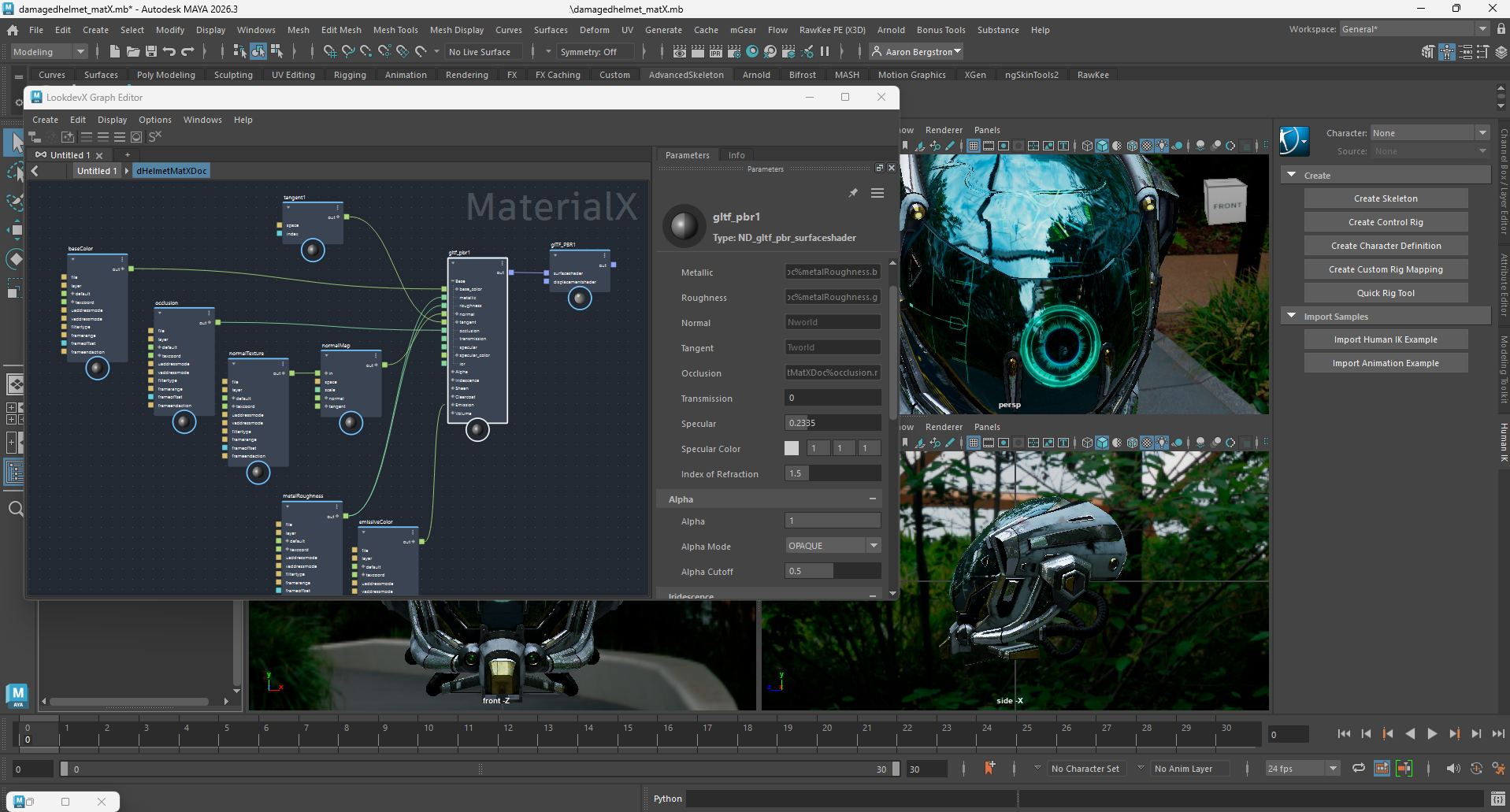
Using Compound Nodes in Maya LookdevX
I've been hard at work this weekend, trying to come up with a workflow that will integrate with MaterialX shader exports into RawKee exports.





Using Compound Nodes in Maya LookdevX
I've been hard at work this weekend, trying to come up with a workflow that will integrate with MaterialX shader exports into RawKee exports.
Starting the RawKee Blog
A consortium of leading cultural institutions has announced a draft specification for presenting computer-based 3D content.
Implementing X3D (open source and royalty free) in e-commerce can significantly enhance product visualization and customer interaction. By following this workflow, businesses can create a seamless and engaging shopping experience that leverages the power of 3D technology.
Blender, the powerful open-source 3D creation suite, offers robust capabilities for creating, manipulating, and exporting 3D content in various formats.
X‑Ite, X3DOM, and the Castle Game Engine — three tools that all deal with X3D. Together, they form a complete ecosystem for 3D Web visualization.
The Convergence of X3D and Artificial Intelligence: Reshaping Digital Realities. Web3D Consortium's special Interest Group, AI with X3D aims to explore, develop, and promote the interation of artificial intelligence technologies withi
The 3D web is entering a new era—one defined by openness, interoperability, and immersive experiences that run everywhere. At the center of this evolution stands X3D Version 4, the latest generation of the ISO‑standardized framework for declarative 3D graphics.
What happens when enterprise 3D graphics meets the World-Wide Web? When peanut butter and chocolate meet? The answer, of course, is ‘Delicious Things’!
In today’s fast-moving digital landscape, X3D (Extensible 3D) has emerged as a cornerstone technology for interactive web-based 3D graphics.
The 3D web has evolved from experimental to a mature ecosystem powering cultural heritage, e‑commerce, scientific visualization, digital twins, and immersive storytelling.
There is great excitement around the development of new features and formats, from glTF 2.0 to X3D 4.0. This blog provides a high-level view of the leading open formats and how and why they should be used together.
The term ‘Metaverse’ has taken on a new sparkle recently, appearing prominently in the marketing materials of a number of large technology companies. Indeed, many have attempted, or are attempting, to co-opt it for their own purposes, which has resulted in a great deal of confusion among producers and consumers in the marketplace. With this short position paper, the Web3D Consortium seeks to address this confusion by exploring the history of the ‘Metaverse’ that has led us to our current state, providing a workable definition of the term ‘Metaverse’, and providing a vision for its sustainable, cooperative construction into the future. We believe that all the technologies are in place to fulfill the vision of an open, equitable, and ubiquitous information space. What remains are the key issues that have kept the Metaverse from manifesting the last two decades: user experience and corporate cooperation. See attached paper below.
 Great Projects by our Members
 The Most Widely Used Formats
 X3DOM... 3D Without Plugins
 X3D and VRML